
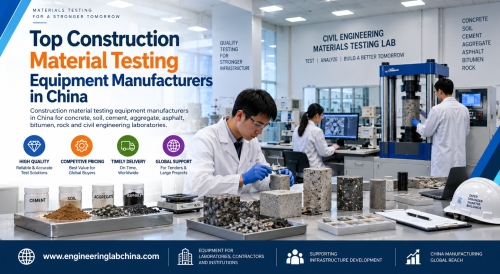
Construction quality depends heavily on the materials used in a project. Concrete, cement, soil, aggregates, asphalt, bitumen and rock must be tested to determine whether their properties are suitable for the intended application and project specifications. This makes construction material testing equipment an essential part of civil engineering laboratories, construction companies, infrastructure projects, universities, testing laboratories and quality-control departments.
EngineeringLabChina is among the Construction Material Testing Equipment Manufacturers in China, offering a comprehensive range of testing instruments and laboratory equipment for international buyers, distributors, contractors, educational institutions and project procurement.
Our range covers equipment for concrete testing, soil testing, cement testing, aggregate testing, bitumen and asphalt testing, rock testing and general material testing. Equipment can be supplied individually or as part of a complete civil engineering and construction material testing laboratory.
Construction Material Testing Equipment Manufactured in China
Construction materials behave differently under compression, loading, moisture, temperature and environmental conditions. Laboratory and field testing helps engineers measure these properties before materials are approved for use.
A complete construction material testing laboratory may therefore require several groups of instruments rather than a single testing machine.
EngineeringLabChina provides equipment covering major construction material testing applications, including:
-
Concrete testing equipment
-
Soil and geotechnical testing equipment
-
Cement and mortar testing equipment
-
Aggregate testing equipment
-
Bitumen testing equipment
-
Asphalt testing equipment
-
Rock testing equipment
-
Compression and strength testing machines
-
Material testing machines
-
Laboratory accessories and sample preparation equipment
The exact configuration of a laboratory depends on the materials being tested, applicable test methods, required testing capacity and project specifications.
Concrete Testing Equipment
Concrete is one of the most extensively used construction materials worldwide. Its quality can directly influence the strength, durability and service life of buildings and infrastructure.
Concrete testing equipment is used to evaluate fresh and hardened concrete at different stages, from mix preparation and workability testing to compressive strength assessment.
Common concrete laboratory requirements can include:
-
Concrete compression testing machines
-
Slump test apparatus
-
Concrete cube moulds
-
Cylinder moulds
-
Concrete mixers
-
Vibrating tables
-
Needle vibrators
-
Compaction factor apparatus
-
Vee Bee consistometers
-
Air content meters
-
Concrete permeability apparatus
-
Concrete test hammers
-
Concrete core cutting equipment
-
Curing tanks and curing equipment
Concrete Compression Testing Machines
The concrete compression testing machine is one of the most important pieces of equipment in a construction materials laboratory.
It is used to determine the compressive strength of prepared concrete specimens. Different machine capacities and control configurations can be selected according to laboratory and project requirements.
For laboratories handling routine quality-control work, the testing machine should be selected according to specimen dimensions, anticipated loads, testing frequency and required test method.
Fresh Concrete Testing Equipment
Before concrete hardens, several properties can be evaluated to monitor its consistency and workability.
Slump cones, compaction factor apparatus, air content meters and related instruments allow laboratory technicians and site engineers to assess fresh concrete before placement.
Combining fresh and hardened concrete testing provides a more complete picture of concrete quality.
Soil Testing Equipment
Before foundations, roads, embankments or other structures are constructed, engineers need information about the properties of the soil supporting them.
Soil testing equipment is used in geotechnical and civil engineering laboratories to investigate characteristics such as moisture content, density, compaction, shear strength, permeability and bearing behaviour.
The range can include:
-
CBR testing machines
-
Proctor compaction apparatus
-
Direct shear apparatus
-
Consolidation apparatus
-
Triaxial testing equipment
-
Liquid limit apparatus
-
Plastic limit equipment
-
Soil permeability apparatus
-
Soil density equipment
-
Sand replacement apparatus
-
Soil hydrometers
-
Soil sampling equipment
-
Moisture content equipment
-
Unconfined compression testing equipment
-
Laboratory sieves and sieve shakers
CBR Testing Equipment
California Bearing Ratio testing equipment is widely associated with soil and pavement investigations.
The test helps evaluate the bearing characteristics of subgrade and base materials used in road construction. Depending on the laboratory requirement, CBR systems can include loading frames, moulds, penetration components and associated accessories.
Soil Compaction Testing
Compaction has an important influence on the performance of soils used in construction.
Proctor compaction apparatus and related equipment help laboratories investigate relationships between moisture content and dry density under specified compaction conditions.
Soil Mechanics and Geotechnical Laboratories
EngineeringLabChina can also provide soil mechanics laboratory equipment for universities, technical institutes, geotechnical laboratories and infrastructure projects requiring multiple soil-testing experiments within one laboratory.
Cement & Mortar Testing Equipment
Cement is a fundamental component of concrete and mortar, and its physical properties require careful evaluation during manufacturing, construction and quality control.
Cement testing equipment can be used for determining characteristics such as consistency, setting time, fineness, soundness and strength.
Typical equipment includes:
-
Vicat apparatus
-
Le Chatelier apparatus
-
Blaine air permeability apparatus
-
Cement compression and flexural testing machines
-
Mortar mixers
-
Cement moulds
-
Jolting apparatus
-
Flow tables
-
Cement autoclaves
-
Length comparators
-
Specific gravity equipment
-
Laboratory balances
-
Cement sieves
Vicat Apparatus
The Vicat apparatus is commonly used in cement laboratories for evaluating consistency and setting characteristics according to the applicable test procedure.
Cement Strength Testing
Prepared mortar specimens can be tested to evaluate mechanical performance. Compression and flexural testing equipment can therefore form an important part of cement laboratory installations.
Cement manufacturers, commercial laboratories and construction-material testing facilities may require complete combinations of sample preparation, curing and strength-testing equipment.
Aggregate Testing Equipment
Aggregates form a significant portion of concrete and are also widely used in road construction, asphalt mixtures, railway work and other infrastructure applications.
Their size, shape, strength, abrasion resistance and other physical properties can influence the behaviour of the finished construction material.
Aggregate testing equipment can include:
-
Aggregate crushing value apparatus
-
Aggregate impact value apparatus
-
Los Angeles abrasion testing machines
-
Deval abrasion equipment
-
Flakiness gauges
-
Elongation gauges
-
Density baskets
-
Aggregate sieves
-
Sieve shakers
-
Sample dividers
-
Bulk density measures
-
Specific gravity equipment
Los Angeles Abrasion Testing Machine
The Los Angeles abrasion testing machine is used to evaluate the resistance of aggregate to wear and degradation under specified test conditions.
It is commonly found in road, concrete and construction-material laboratories.
Aggregate Crushing and Impact Testing
Crushing and impact tests provide information about how aggregates behave when subjected to mechanical forces.
These properties are particularly relevant when selecting aggregates for concrete, pavement and other demanding construction applications.
Bitumen Testing Equipment
Bitumen used in road construction and waterproofing applications needs to exhibit suitable physical and performance characteristics.
Bitumen testing equipment allows laboratories to evaluate important properties according to the required test method.
The equipment range can include:
-
Bitumen penetration apparatus
-
Ductility testing machines
-
Softening point apparatus
-
Saybolt viscometers
-
Bitumen extraction equipment
-
Flash and fire point apparatus
-
Loss-on-heating equipment
-
Specific gravity equipment
-
Bitumen laboratory ovens
-
Water baths
Bitumen Penetration Testing
Penetration testing is used to characterize bituminous materials under specified test conditions.
The appropriate apparatus, accessories and temperature-control equipment should be selected according to the test procedure being followed.
Ductility and Softening Point Testing
Ductility testing evaluates deformation characteristics, while softening point testing investigates behaviour as temperature increases.
Together with penetration, viscosity and other tests, these measurements help laboratories characterize bituminous materials.
Asphalt Testing Equipment
Although asphalt and bitumen are closely related categories, buyers frequently search specifically for asphalt testing equipment, particularly for road construction and pavement laboratories.
Asphalt testing laboratories may require equipment for:
-
Asphalt mix preparation
-
Marshall stability testing
-
Asphalt compaction
-
Density testing
-
Binder extraction
-
Asphalt content determination
-
Sample preparation
-
Core cutting
-
Pavement evaluation
Marshall Stability Testing Equipment
Marshall stability testing equipment is widely used for evaluating asphalt mixtures.
A complete setup may include a loading frame, compaction equipment, moulds, water baths and other accessories required for sample preparation and testing.
For road laboratories, asphalt and bitumen equipment are often procured together because both binder properties and completed asphalt mixtures need to be evaluated.
Rock Testing Equipment
Rock testing is important in geotechnical engineering, mining, tunnelling, dams, foundations and other infrastructure applications.
Rock testing equipment is used to investigate mechanical and physical properties of rock specimens.
Typical equipment can include:
-
Point load testing apparatus
-
Rock compression testing machines
-
Core drilling machines
-
Core cutting equipment
-
Rock sample preparation machines
-
Slake durability apparatus
-
Rock permeability equipment
-
Rock shear testing equipment
-
Core extractors
The exact equipment required depends on the type of investigation and the properties being evaluated.
Ceramic, Tile and Building Material Testing Equipment
Construction laboratories may also need to evaluate ceramic tiles, floor tiles, marble, porcelain and related building materials.
Testing can cover properties such as strength, abrasion resistance, impact behaviour, dimensions and surface performance.
For buyers establishing a broader construction materials laboratory, these instruments can complement conventional concrete, cement, aggregate and rock testing equipment.
Material Testing Machines for Construction Laboratories
Many construction laboratories require machines capable of measuring mechanical properties under controlled loading.
Depending on the application, these can include:
-
Compression testing machines
-
Universal testing machines
-
Tensile testing machines
-
Flexural testing machines
-
Load frames
-
Digital testing machines
-
Computer-controlled testing systems
Machine selection should be based on the material, specimen size, anticipated load, required accuracy, applicable test method and laboratory workload.
Construction Material Testing Equipment for Civil Engineering Laboratories
A civil engineering testing laboratory can serve several purposes.
Universities and technical institutions use laboratory equipment to demonstrate material behaviour and testing principles to students. Commercial laboratories perform testing for construction companies and project owners. Contractors may establish project laboratories for continuous quality control during construction.
As a result, there is no single standard equipment package suitable for every laboratory.
EngineeringLabChina can provide equipment for:
Educational laboratories – civil engineering colleges, universities and technical institutes.
Commercial testing laboratories – independent facilities conducting construction material tests.
Construction companies – laboratory and field testing equipment for project quality control.
Road laboratories – equipment for soil, aggregate, bitumen and asphalt testing.
Concrete laboratories – equipment for fresh concrete, specimen preparation, curing and strength testing.
Cement laboratories – equipment for cement and mortar physical and mechanical testing.
Geotechnical laboratories – soil and rock testing equipment for engineering investigations.
How to Select Construction Material Testing Equipment
Selecting equipment simply from a general catalogue can result in purchasing instruments that do not correspond to the required test method.
Before requesting a quotation, buyers should ideally identify the following:
1. Material to Be Tested
Determine whether the laboratory will test concrete, soil, cement, aggregates, asphalt, bitumen, rock or several materials.
2. Required Test Methods
Identify the individual tests that need to be performed. This helps determine the equipment, accessories and specimen preparation requirements.
3. Testing Capacity
Compression machines and other loading systems are available in different capacities. Equipment should correspond to the anticipated specimens and loads.
4. Manual, Digital or Automatic Operation
Depending on the equipment, buyers may have a choice between manual, digital, semi-automatic or computer-controlled configurations.
The appropriate option depends on laboratory workload, reporting requirements and project specifications.
5. Applicable Standards
Construction material testing is often carried out according to specified national or international test methods. Buyers should state the applicable standard when requesting equipment.
6. Power Supply
International buyers should specify the electrical power supply required at the final installation location.
7. Complete Accessories
Testing equipment frequently requires moulds, fixtures, accessories, sample preparation equipment or consumables. These should be considered when preparing a complete laboratory requirement.
Construction Material Testing Equipment for International Tenders
Government departments, universities, road authorities, infrastructure projects and international development programs frequently procure civil engineering and construction testing equipment through tenders.
Tender schedules can contain dozens or even hundreds of individual instruments covering multiple laboratory sections.
EngineeringLabChina supports buyers and project companies requiring construction material testing equipment from China for international tenders.
Buyers can provide:
-
Tender documents
-
BOQ or equipment schedules
-
Technical specifications
-
Required quantities
-
Applicable standards
-
Destination country
-
Required documentation
The equipment requirement can then be reviewed item by item according to the technical specifications.
Bulk Supply of Construction Testing Equipment from China
International distributors and project contractors may need more than one laboratory instrument.
Requirements can range from multiple compression testing machines to complete laboratory packages containing equipment for concrete, soil, cement, aggregate, bitumen and asphalt testing.
EngineeringLabChina supports bulk supply of construction material testing equipment from China for distributors, contractors, educational institutions and international projects.
Consolidating multiple testing categories within one procurement package can also simplify project purchasing where a complete construction materials laboratory is required.
Why Choose EngineeringLabChina for Construction Material Testing Equipment?
EngineeringLabChina focuses on providing a broad selection of construction and material testing equipment manufactured in China for international markets.
Instead of limiting buyers to one category, our range covers the major equipment groups needed to establish and expand civil engineering and construction-material laboratories.
Buyers can source equipment for:
-
Concrete laboratories
-
Soil and geotechnical laboratories
-
Cement laboratories
-
Aggregate laboratories
-
Asphalt and bitumen laboratories
-
Rock mechanics laboratories
-
Building material laboratories
-
Civil engineering teaching laboratories
-
Construction project quality-control laboratories
This broad product coverage makes EngineeringLabChina a practical source for distributors and project buyers looking for Construction Material Testing Equipment Manufacturers in China.
Request Construction Material Testing Equipment from China
If you are establishing a new civil engineering laboratory, expanding an existing testing facility or preparing a tender for construction testing equipment, send EngineeringLabChina your equipment schedule, BOQ or technical specifications.
We offer a comprehensive range of concrete testing equipment, soil testing equipment, cement testing equipment, aggregate testing equipment, bitumen and asphalt testing equipment, rock testing equipment and material testing machines manufactured in China.
Requirements can be evaluated for individual instruments, bulk quantities or complete laboratory packages for international projects.
EngineeringLabChina – Construction Material Testing Equipment Manufacturers in China for Civil Engineering Laboratories, Infrastructure Projects, Bulk Orders and International Tenders.
